

In memoria di me
Until 29 November
A new exhibition, a new site-specific project, a reflection on time and memory
A long-standing body of literature has intertwined the fate of art with the cult of death.
Art has depicted death in the imagery of the archaic past just as it has in medieval iconography. The Triumph of Death, the Dance of Death, and the vanitas compositions featuring flowers that fade with the passing of time have all contributed to a rich visual repertoire which, from Dürer’s skeletons to Caravaggio’s rotten apples, traces a long, painful yet deeply moving history of humanity’s engagement with the mysteries of mortality.
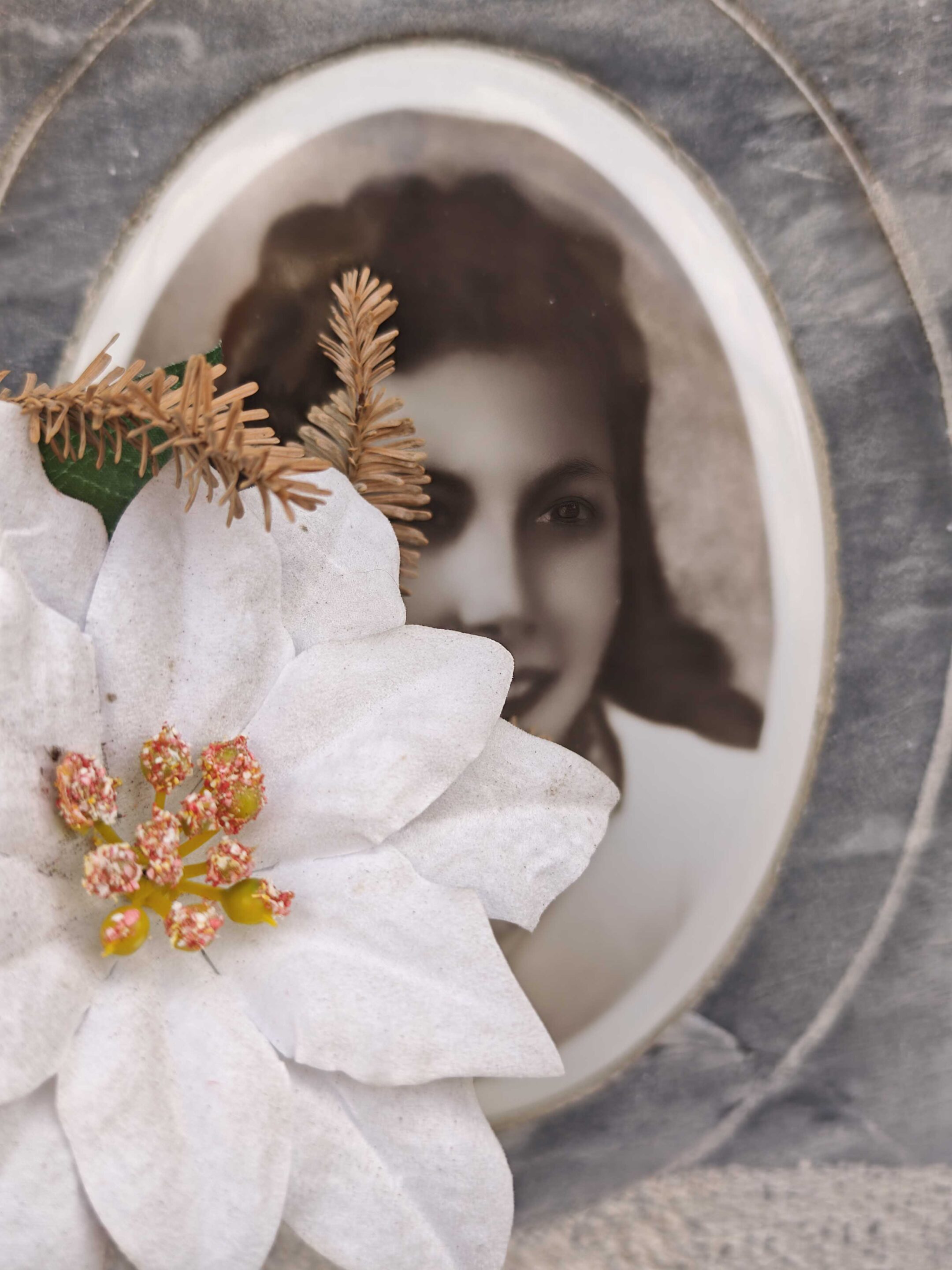
The work of Giusy Calia, In memoria di me – presented by the museum as a recent acquisition to its permanent collection – is the result of a deeply moving reflection by the Nuoro-born artist on the subject of death, but above all on that of memory.
The camera lens delves into the faces captured in old photographs, surrounded and partly concealed by petals. Identity gradually fades with the passing of the years, just like the image that intermittently brings it back into view. The close-up penetrates the very substance of the image, a space in which a poignant form of survival takes place. The fragility of the flower is the same as that of the portrait. The serial nature of the narrative becomes a mapping of individual memories and, at the same time, of collective ones, brought together in a chorus of images that unfolds before our eyes like a gigantic, monumental memento mori.
The theme establishes a subtle connection with existential literature, somewhere between Satta’s Il giorno del giudizio and the Spoon River Anthology, through the powerful idea of an encounter with the dead in a cemetery and the evocation of a land suspended between past and present, aristocracy and ordinary people, disillusionment and metaphysics, personal history and universal history.
Here, pietas is renewed through a dialogue with Antonio Ballero’s 1908 work Sa Ria, as well as through an ideal reference to Deledda’s La via del male, which offers a glimpse into the traditions of mourning in Barbagia society, whose most ritualistic aspects Ballero also portrays. The Sardinian term «sa ria» refers to the grief expressed by women gathered around the hearth when mourning a loss. And it is precisely this suffering that emerges from a dimly lit interior, inhabited by female figures dressed in traditional Nuoro garments, gathered around a fire that has now gone out.