

August 12 – September 27
August 12 – September 27
Two perspectives, one soul: Sardinian identity preserved in the paintings of artists and expressed in gold and silver through the skilled craftsmanship of master goldsmiths.
With the collaboration of Agostino Basile
Bringing painting and goldsmithing into dialogue in the Barbagia region means exploring a territory where nineteenth- and twentieth-century art and traditional craftsmanship converge in a shared narrative of identity.
Along this conceptual journey, artworks and precious objects reflect one another, revealing the connections between a cultural, geographical, and anthropological heritage. In the paintings, jewellery takes on a life of its own: gold and silver filigree buttons are no longer merely functional elements, but become symbols of light; amulets emerge imbued with their ancient apotropaic and protective powers; large silver rosaries convey the profound religious devotion of Sardinian women, while gold clasps reveal their personal taste and sense of adornment.
This close dialogue demonstrates how Sardinian artists understood jewellery not as a decorative addition, but as an embodiment of the collective identity of a people.
It is precisely this heritage of shared memories, knowledge, and symbols that MAN explores in anticipation of the Festa del Redentore, when Nuoro prepares to host one of Sardinia’s most deeply rooted and celebrated traditions, bringing traditional costumes from across the island together in the streets of the city.
In the galleries of MAN, the exhibition brings together works by artists represented in the museum’s permanent collection who, throughout the twentieth century, explored and portrayed Sardinian traditions, each through their own artistic language and sensibility. The central theme is the human figure, defined not only by clothing but also by details such as jewellery, which express an individual’s sense of belonging to a community and a specific territory.
The journey begins with Edina Altara’s Modern Bride, an expression of twentieth-century decorative art, and continues with the more deeply rooted tradition represented by Carmelo Floris’s Bride of Ollolai. In a restrained style, far removed from folkloric representation yet marked by a sense of bourgeois detachment, are Francesca Devoto’s two female figures, Girl with Necklace and Costume of Desulo. Earlier works by Francesco Ciusa capture the distinctive headdress of Desulo in Laughing Girl and Madonna and Child. In both the monochrome sculpture and bas-relief, the only touches of colour are provided by the headdresses, rendered in the vivid shades of blue, red, and yellow characteristic of the mountain village. A leap forward in time brings us to the work of the renowned photographer Franco Pinna, who, through his numerous photographic essays on Sardinia, documented moments of celebration and communal life, preserving images of costumes, jewellery, and rituals that bear witness to the island’s cultural identity.
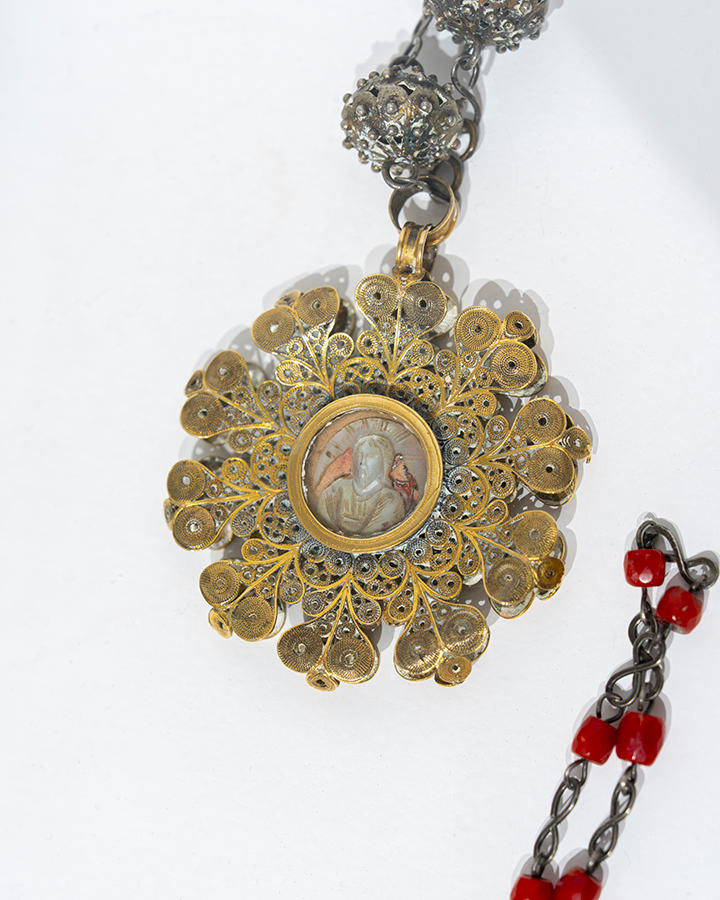
The exhibition journey also features a selection of original jewellery from a private collection, dating from the eighteenth and nineteenth centuries and the early decades of the twentieth century. Jewellery used to fasten garments—including buttons and clasps—is displayed alongside devotional objects such as rosaries (testales and coronas in silver filigree, a gold paten, mother-of-pearl, glass paste, rough garnets, lapis lazuli, turquoise, and coral). Objects associated with personal care, such as ispurgadentes, featuring silver chains interspersed with amulets and relics, are presented alongside items of personal adornment, including necklaces, bracelets, and gold coins. Particularly significant are the apotropaic jewels, a series of silver and obsidian amulets (allèrios), and reliquaries (pungas).
Jewellery serves as a means of invoking divine grace and warding off evil; it accompanies individuals throughout the various stages of life, from birth to death, and protects the unborn from the dangers of the evil eye (s’ocru malu). At the same time, jewellery is a powerful expression of human desire: it conveys wishes, offers protection, embodies vanity, and seals the promise of marriage as a symbol of eternal love. Whether crafted by hand or represented in paintings, these objects embody a rich tradition in which devotion and beauty are closely intertwined.
MAN presents this exhibition as part of its ongoing commitment to the study, interpretation, and enhancement of its collections. Each project offers an opportunity to explore new themes, iconographies, subjects, and artists, while establishing meaningful connections with the lesser-known cultural heritage of the local community.