

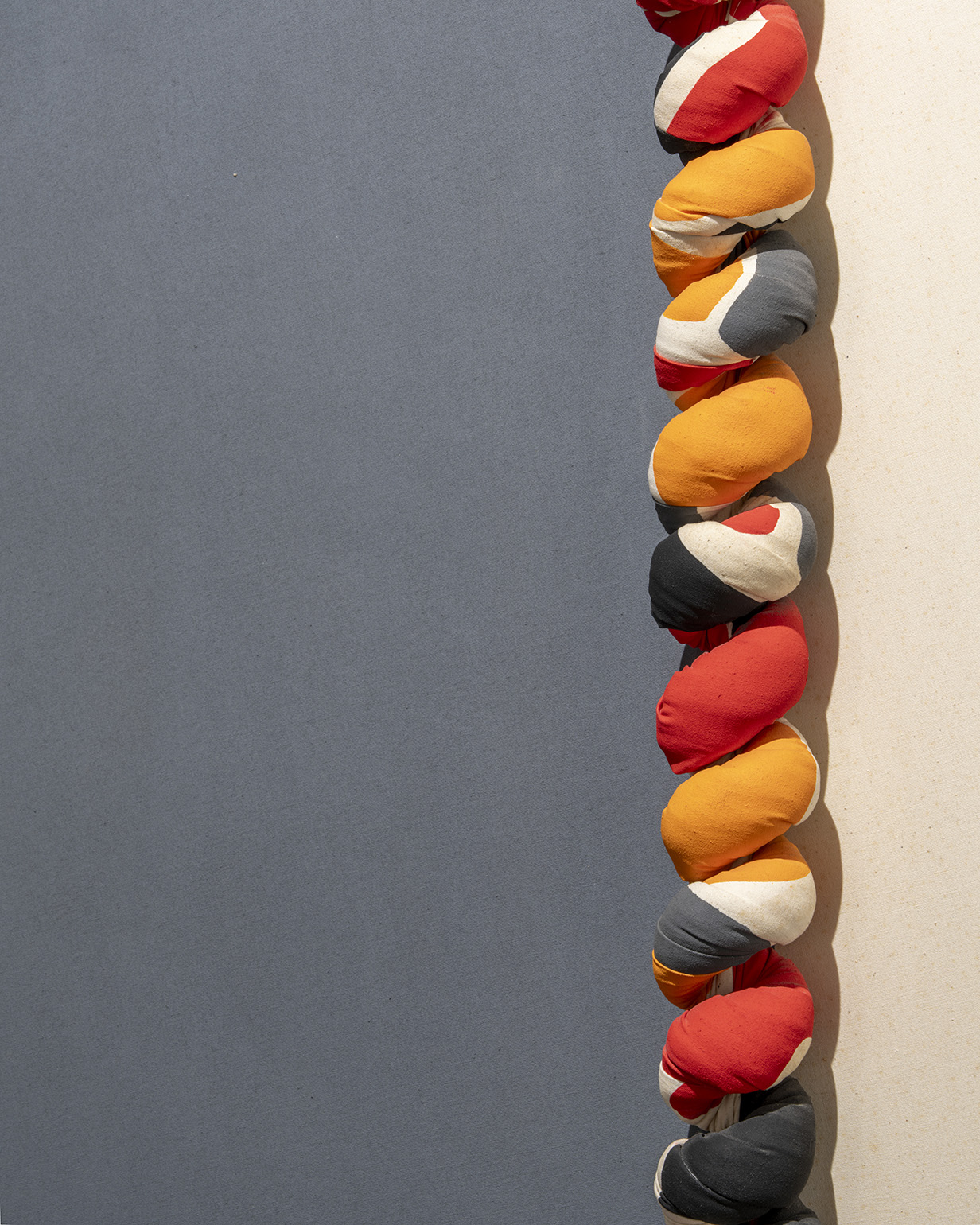
From Madre che cuce by Sironi to a large tapestry by Enrico Baj, from Tela cucita by Maria Lai to designer seating by Martí Guixé.
After the important focus on the group of works by Francesca Devoto held in the MAN collection, the third exhibition in the Appartenenze presents a selection of works from the museum’s permanent collection, brought together by the themes of weaving and sewing, understood as forms of artistic expression, as gestures of the hand, but also as technical experimentation and as a traditional language reinterpreted in a contemporary way.
The exhibition path ranges from a masterpiece such as La madre che cuce by Mario Sironi (1905–1906), a work from his Divisionist period, to the first Tela cucita by Maria Lai, created in 1975. The series of the Tele cucite and the Telai represent a fundamental part of the artistic research of the artist from Ulassai.
The Sardinian tradition of weaving was, for Maria Lai, both a medium and a language through which she explored complex themes such as human relationships, brotherhood, sharing, collective time, the sacredness of everyday life, the rhythms of human existence, and the anthropological need to connect with others within a shared and vital space. “Essere è tessere” (“To be is to weave”) was in fact one of her recurring mottos.
Associated with this work are two large Geografie (1986 and 1994) and two libri cuciti (1987 and 1999), the latter of which is also connected to the theme of the Geografie series itself.
Also taking part in a dialogue with Lai is her friend and colleague Jorge Eielson, present in the exhibition with the work Amazzonia, a knotted canvas that draws on the language of knots and quipu from Inca culture. The Peruvian artist, who was active in Sardinia, created the work in his Ogliastra studio during the years of his close artistic partnership with Maria Lai.
The result of an important recent donation, formalized by the Enrico Baj Archive, the large tapestry by the Milanese master is being presented to the public for the first time since its creation in 1987, on the occasion of the exhibition Taccas, nuovi tappeti sardi, promoted by ISRE and introduced by Giovanni Lilliu.
The work Omaggio a Muybridge, made of wool and created by the Brai sisters from Zeddiani, features a motif inspired by the famous experimental photographs of the British photographer, a pioneer of motion photography. A recent acquisition, it enriches the MAN permanent collection with the work of a major twentieth-century Italian master.
At the centre of the room are the MANica Next Seat chairs by the Barcelona-based artist and designer Martí Guixé, who, drawing on Sardinian traditional fabrics and motifs, creates furnishings in which memory meets experimentation.