

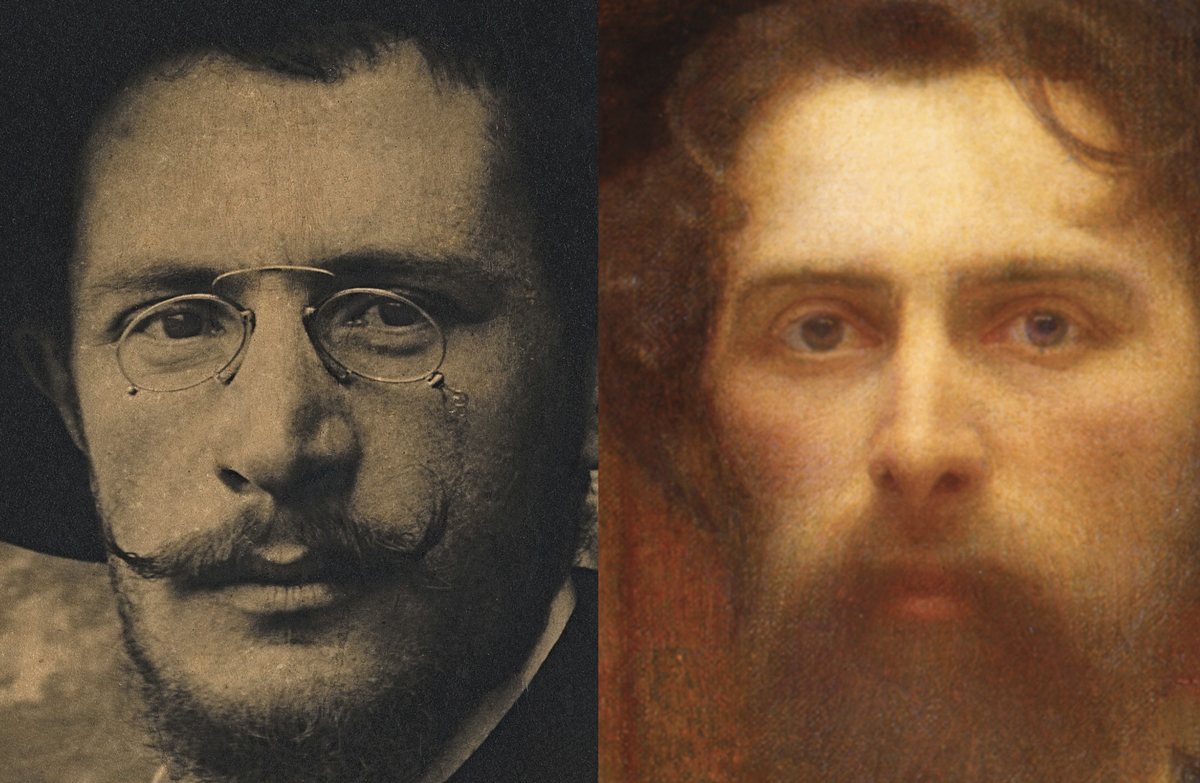
curated by Chiara Gatti on a project by Rita Moro
with the scientific contribution of Gabriella Belli and Antonello Cuccu
13 March – 14 June 2026
inauguration: Friday 13 March at 7 pm
A friendship, an exchange of correspondence, a shared vocation for landscape, painting, for translating nature into heartbeats of vibrant colour. This new project launched by the MAN Museum of Nuoro aims at tracing the ideal heritage that Giuseppe Pellizza da Volpedo (1868-1907), the noble father of Italian Divisionism, passed down to Antonio Ballero (1864-1932), a Sardinian artist who, suspended between past and progress, ferried a style of painting still imbued with precepts of Realism towards the experimental explorations of Divisionism, conveying the late-romantic culture that distinguished the artistic landscape of Sardinia of the time in the direction of a scientific investigation into colour, without neglecting a vibrant narrative of the images transposed onto the canvas. Antonio Ballero and Pellizza da Volpedo were bound by mutual esteem, a strong bond that was broken by the tragic death of the Piedmontese artist. Drawing on Pellizza da Volpedo, Ballero vigorously contributed to introducing Sardinia to the new language of painting and the theories delving into the “separation” of colours, which were at the heart of the artistic debate on the national and international scale. It was precisely thanks to the lesson learned from Pellizza da Volpedo and an intense intellectual exchange with the latter that Ballero managed to conquer a leading role in the evolution of the artistic exploration experienced by his Island, which rightfully took an active role – via his action – in the debate that was shaking the landscape of art on the ‘mainland’.
This project, curated by Chiara Gatti and coordinated by Rita Moro, with the scientific counselling of Gabriella Belli, a major scholar of Italian Divisionism, and of Antonello Cuccu, a scholar and expert of Sardinian art, explores the close connection between the solutions devised by the Sardinian master and the spur he received from his privileged relationship with Pellizza da Volpedo through an iconographic comparison and the letters the two artists exchanged between 1904 and 1907, which document their contacts and their intense dialogue. Two works by Ballero were praised by Pellizza and labelled as a true “revelation”, as he personally declared to the Sardinian artist in a brief letter. It was through and thanks to this ideal closeness that Ballero’s expressive and formal exploration shifted towards an aesthetic growth strewn with new and more powerful social content.
The exhibition path comprises over thirty works distributed by sections. They include ten masterpieces by Pellizza da Volpedo on loan from important Italian museums and galleries: the Gallerie degli Uffizi in Florence, the Museo Nazionale Scienza e Tecnologia Leonardo da Vinci in Milan, the Galleria d’Arte Moderna in Milan, the Galleria Civica d’Arte Moderna e Contemporanea in Turin, the Pinacoteca Divisionismo in Tortona, and the Pinacoteca in Alessandria; besides public and private collections that provide ongoing preservation and curatorial support for Antonio Ballero’s oeuvre, including the Municipality of Atzara and the MAMA Museum, the Chamber of Commerce, Industry, Craft, and Agriculture of Nuoro, the Banco di Sardegna bank, and the MAN Museum of Nuoro with its collection of ten works by the Sardinian master. Thanks to a collaboration with the Ilisso publishing house of Nuoro, the art exhibition will also display precious archival material, the correspondence exchanged between the two artists, coeval photographs of the Quarto Stato (The Fourth Estate), and period photographs of Ballero and Nuoro.
Antonio Ballero debuted as a painter at the Esposizione Artistica Sarda (Sardinian Art Exhibition), held at the Palazzo della Provincia in Sassari in 1896. He would soon distinguish himself on a national level after swiftly detouring a Realism of macchiaioli imprint and a poetic feeling for the painted subject, mostly landscapes, and rather looking to the new style introduced by Divisionism and its multifaceted and variable conception of light and colour that was to be tackled via an innovating scientific method applied to painting. The style advocated by Ballero earned him the accolade of Pellizza da Volpedo. Salvatore Farina – an experimental writer born in Sorso who had moved to Milan, where he became closely associated with the Scapigliatura and the Italian intelligentsia of the time – also acknowledged Ballero’s breakthrough in the art world and paralleled his action to Giovanni Segantini, to his lyrical balance between Realism and Symbolism, between a daily life imbued with mundane concerns and a reified sacred dimension that takes shape in the spectacle of nature and in the silent gestures that man performs to pay homage to the universe.
Ballero’s bonds and acquaintances with authors of the calibre of Grazia Deledda and Francesco Ciusa, in Sardinia, and of Leonardo Bazzaro and Carlo Fornara, speaking of artists active in the rest of Italy, contributed to stirring his vocation to give voice to and recount the diuturnal existence of the humble. His dignified figures, solemn yet fragile in the face of the cosmos, inhabit rural horizons where the profound sense of truth in things is sublimated in a timeless expectation. “The paramount pride of shepherds wandering through the bush, the wild galloping of horses, or the willowy and joyful movements of dancers”: that is how Ballero described his subjects, who held on tightly to the traditions of his native land while being projected into the absolute. The radical shift from works such as Paesaggio con alberi (Landscape with Trees) from 1890 to paintings such as Mattino di Marzo (A March Morning) from 1903 ca. or L’appello serale (Evening Call) from 1904, clearly shows the turning point of the Sardinian artist: the heritage of Corot with his use of colour tones, fluid brushstrokes, and vibrant naturalism, which Ballero adhered to in his juvenile years, was forsaken to the benefit of a painting achieved with small patches, complementary colours, penetrating twilights, and a choral vision of the characters.
Pellizza Da Volpedo, four years junior to Antonio Ballero but already in the spotlight of the national artistic landscape, shared his vision with his peer from Nuoro: his thoughts on the theme of landscape, on the spirit of truth, and the power of observation that life requires to be grasped and translated into images, through its intimate and continuous flow. Tracing a connection between the two artists and advancing points of contact therefore means to delve into the richness and results of their dialogue, into the heritage that Pellizza passed down to his friend and how the latter managed to add his contribution to this legacy in his native land, an environment marked by a different, extremely reserved culture, profoundly tied to and dependent on the harshness of its mountains and heart-wrenching tasks of shepherds. An analysis of the conception of Pellizza’s paintings – the scenes that filled his eyes when he glimpsed at moments of daily rural life, suffering because of poverty notwithstanding a mystical hope for a better future – may help understand the evolution of Ballero’s style: the way he embraced a new poetics of everyday life. By wandering across villages, or bordering alleys overlooking barns, we may identify the stages of a journey and pinpoint them according to main themes.
A New Technique for a New Light
Some surviving works from 1894 document Antonio Ballero’s relentless studies on the issue of a relationship between colour and light and colour and material. This milestone date marks the development and growth of his production. Further to his participation at the historical Esposizione Artistica Sarda (Sardinian Art Exhibition) in 1896, when his name was spotlighted along with his senior and more famous peer, Giacinto Satta, Ballero received the acknowledgement for his expressive talent from critics up-to-date with new explorations in the art field. The artistic scenario was at the time divided into two fronts: the advocates of the achievements of Pointillisme in France, on the one hand, and the coeval spreading of a scientific method focusing on the separation of colours championed by Divisionists in Italy, on the other. The latter allowed for greater freedom as to sign and gesture in contrast to the stern rigorousness of their French counterparts. It is no coincidence that 1896 was the year of the Turin Triennale, which enjoyed the participation of outstanding names, including Morbelli, Grubicy, Longoni, Nomellini, Previati, Tominetti, who displayed paintings created by relying on the Divisionist technique. It goes without saying that the number of these innovative paintings was decidedly lower than canvases drawing on traditional languages. However, they were crucial in setting a point of departure for the revolution that was about to take place. “Keeping colours separate and close to one another, rather than mixing them on the palette”, as Grubicy codified in the pages of the Triennale, held in the same year, became common practice to increase the best possible brightness in a painting, whereby this special technique was meant to respond to an expressive need, and was certainly not the ultimate goal of a flaunting virtuoso. “[…] I firmly believe – Pellizza would later state – that this is nothing but the means to lend greater effect to a work of art, and the result will be more consistent with modern ideals.” At the dawn of the 20th century, the Nuoro-born artist, too, embraced this new technique and stubbornly changed his horizon heading for a separation of chromatic elements, which allowed for the creation of enveloping light effects, patches of shadow, and flickering flares, the intensity of which had never been achieved before. In the wake of Pellizza, Antonio Ballero declared in his turn: “The science concerning light and colours should always arouse your interest: only by relying on scientific methods will you acquire confidence of what you are doing. When you replicate the truth, do not think of theories, but rather of translating it with all means at your disposal. Do not embrace Divisionism in and of itself: you must be convinced that your vision will be better expressed by relying on it. When it is too apparent, Divisionism damages a work of art: instead, if you keep its positive principles in mind, the resulting effect is as if you had created your work of art with no effort at all; the work of art must appear as the outcome of a spontaneous gesture. In my opinion, it is not a question of championing a technique that relies solely on dots, or lines, or a blend of pigments; nor entirely smooth or rough, because it varies as the expressions of nature do.”
The Destiny of the Humble
Next to natural phenomena, highlighted by the optical effects created by the Divisionist technique, it is worth underlining the attention devoted by Pellizza da Volpedo and his Nuoro-born peer to a world inhabited by wretched and all the same heroic figures: wrecks, countenances marked by suffering, or motionless persons cloaked in dust. “Once back to my hometown, the first thing I did was to portray my parents […]”, Pellizza recounted in his memories published in Copialettere e minutari in 1895. The extensive literature focusing on realism that permeated the century was retained by Ballero, thanks also to his relationship with Sebastiano Satta and Grazia Deledda. The three artists lived in and shared a land that – not so much dissimilarly from the town of Volpedo – soaked up lifeblood from nature, returning harshness in turn, in a sort of “demoniac sadness” that – quoting Salvatore Satta’s Il Giorno del giudizio (The Day of Judgement) – singled out Nuoro as a “nest of crows”, a steep wasteland, and his prominent people and shepherds as priests and bandits. The true joining link that, in this section, connects Ballero and Pellizza is the feeling of death in the present, the metaphysics that crosses the gaze of their characters, either dead or alive, who are eternally dangling above the cliff of their existence. The characters portrayed by the two masters dialogue, caressed by a compassionate light, using a language that blends Divisionism and sentiment for the sacred in a boundless grievous land. Their figures become the mirror of the entire population living on earth and that is suddenly swallowed up, thanks to the desperate sweetness of a painting that translates the destiny of the humble onto a palette of colours. Ballero’s courtyards, silent and parched in summer, become the symbols of the Sardinian world, of its rhythms, and its social truth.
Art as a Social Function
Against the backdrop of a late 19th-century gentrified Sardinia, the region was hit by the same tragedies that Pellizza blamed by relying on his canvases to condemn them universally. Labour and oppression, poverty and illnesses, fragility and violence that the activism of his art contributed to denouncing with the visual and touching strength of a programmatic manifesto. “It is the works that ennoble the dignity and beauty of humble jobs and the life of people, and that exalt and glorify their joy and sorrow, that will anticipate a true art of the future.” This heartfelt statement, voiced by Ballero in his younger days, would regrettably stumble against the disillusionment with the modern world and a romantic idealism dismayed by the logic of power and labour exploitation. Social unrest spread all over Italy between the two centuries and became a spur to tackle new representations of daily life marked by iniquity, which the social poetics of Divisionist masters translated into accusing images. This was the case of the massacre in Buggerru in 1904, which occurred during a strike of miners that, ideally, can be connected with Pellizza’s masterpiece: the march portrayed in the Quarto Stato (The Fourth Estate), the manifesto of all struggles for the conquest of civil rights at the dawn of modern times. Sardinia experienced social tensions whose extent was certainly not second to what was taking place in the rest of the country. In 1906, thirteen strikes were organised on the Island, and Cagliari staged the notorious revolt of female cigar-makers: this event took place in the month of May, concurrently with the lecture on sculpture held by Ballero. On that occasion, the artist sharply addressed the theme of social function that art was called upon to play, emphatically referring to the social message of works of art that openly revealed a political perspective. The sentiment of an entire epoch, exemplified by the march of peasants and their absolute message of dignity and courage, reached its peak with Pellizza and the heritage he passed down to Ballero, namely the consistency of art with real life: the harbinger of other struggles for the defence of the working class. The seizure of factories by workers anticipated the so-called Biennio Rosso (a two-year period of intense social conflict) and recorded exhausting struggles in a period when the country was facing increasing industrialisation: these battles were immortalised by the masters of colour in their indelible “snapshots” of a country on the edge between tradition and modernity.
The exhibition also spotlights a twelve-minute narrative rich with archival footage, produced by Storyville. The video traces the history of the Quarto Stato (The Fourth Estate), starting with its acquisition via a public subscription. On 17 January 1920, a public call for tenders was launched to gather the necessary funds to purchase the painting, which had remained the property of Pellizza’s heirs. The initial bid was set at fifty thousand Italian liras. That amount was not negotiable. Thanks to the gallery owner Lino Pesaro, the enlightened leftist Milan City Board, led by Mayor Emilio Caldara, had the idea of an open call to raise awareness among locals regarding the ethical sense of the acquisition. The response of the Milanese community was resolute and unanimous. Businessmen, shop-owners, artists, and individual citizens paid free shares, according to their means, in keeping with the feeling of a choral action. On 20 May 1920, the sum due was gathered and The Fourth Estate became a public asset of the City of Milan.
Catalogue published by Edizioni Ilisso
with texts by Gabriella Belli and Antonello Cuccu