

The ISOLA space hosts a series of exhibitions dedicated to the heritage and rich collection of the MAN.
Over a thousand works are held in the museum’s storerooms — works of Sardinian art that, from the late nineteenth century to the present day, document names, themes, paths and research deeply tied to the history, culture and very roots of the territory.
From the verism of Antonio Ballero to the divisionism of the early Mario Sironi, from the return to order of Giovanni Ciusa Romagna to the bourgeois realism of Francesca Devoto, from the abstractionism of Mauro Manca to the extraordinary lives of Salvatore Fancello, Costantino Nivola and Giovanni Pintori, from the exuberant and moving creativity of Maria Lai to the reflections of the latest generations.
A journey spanning a century, now told in this new space of the MAN through in-depth explorations, focused studies and dossier exhibitions. Paintings, sculptures or drawings rarely seen — sometimes never before exhibited — are at the heart of small investigative projects and installations conceived to observe the language of the masters up close, while also offering the public the opportunity to rediscover images that have settled in the memory, a mirror of a community and a symbol of its sense of belonging.
Francesca Devoto. Life in a Room
Francesca Devoto (Nuoro, 1912–1989) was a refined and courageous artist — an artist who swam against the current, moving with ease within an artistic context, that of Sardinia in the 1930s, which was not only predominantly male but also oriented towards a folkloric aesthetic that sat ill with her temperament.
Far from any need to reaffirm her identity through an art straining towards Sardinian tradition, she gazed with curiosity at the changes taking place in her land, turning her eye towards glimpses of bourgeois life.
Born into a well-to-do family from Nuoro, Francesca Devoto pursued her artistic studies in Florence under the guidance of Nerina Simi (daughter of the better-known Filadelfo), before returning to Sardinia in 1931.
Her painting, intimate and refined, favours the theme — partly autobiographical — of the domestic interior. Devoto established herself at the VI Sindacale Exhibition in Nuoro in 1935, and the following year held a major solo show at the Galleria Palladino in Cagliari.
Focus
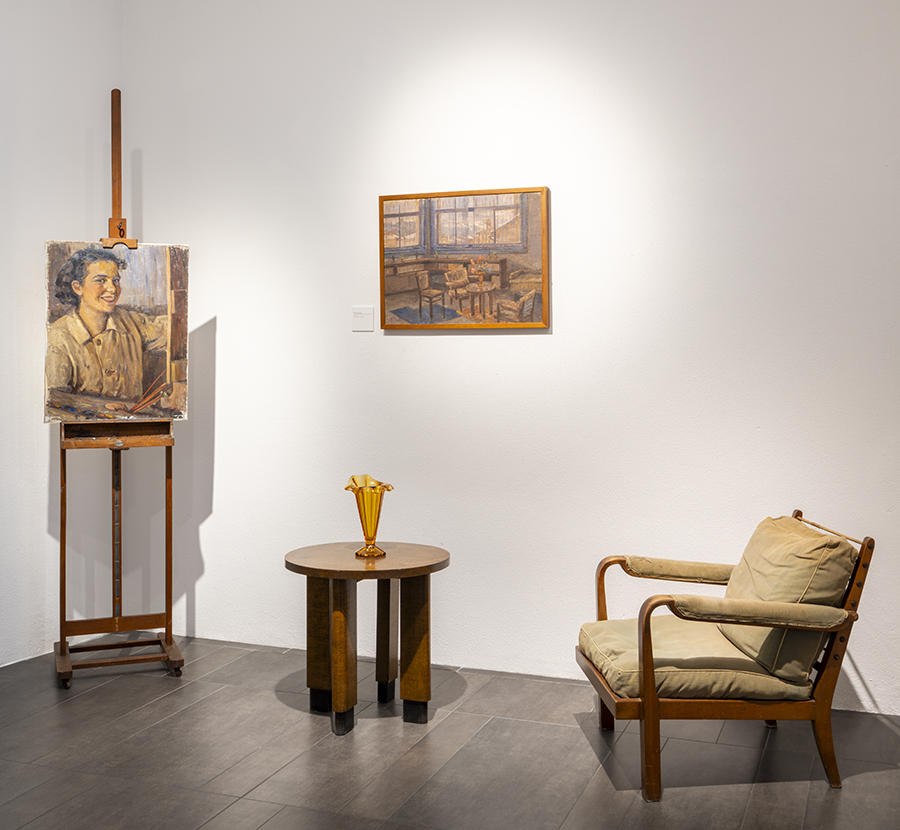
Tina nello studio di via Cavour was created in 1936, when the artist was 24 years old, during a period of intense activity. The work, with its quiet and familiar atmosphere, shows her sister Tina seated in an armchair placed at the centre of her studio.
The woman is dressed in fashionable clothes and is depicted absorbed in reading a book. The setting is a modern and reassuring interior, a physical space that becomes a reflection of an inner dimension. The wide viewpoint allows the viewer to take in every detail, rendered with tonal sensitivity and a diffuse light that creates a delicate balance between figure and surroundings.
Francesca Devoto returned frequently to her bright studio as a subject, just as Tina appears in many of her works. The artist often revisited the same themes, conceiving art as a constant dialogue with her affections — whether people or objects. In her paintings, she portrayed her own life with sincere immediacy — interiors, relatives, her beloved sister — almost as if wishing to preserve their essence as an antidote to the transience of time.
Thanks to the donation of the Devoto heirs, the MAN presents here a reconstruction of the artist’s studio, with its furnishings, easel and amber-coloured glass vase, which recur throughout her poetic paintings.