

From the Museum to the City, from the City to the Museum
– Elisabetta Masala –
In the 1960s and 1970s, Italian sculpture underwent a true revolution. It left the museum halls, abandoned pedestals and monumental squares, and descended among the people into the streets, factories, and schools. In these years, a new idea of space and audience emerged: the artwork was no longer a static object but a collective experience, an opportunity for encounter and participation. Art was no longer something to be contemplated, but something to be lived.
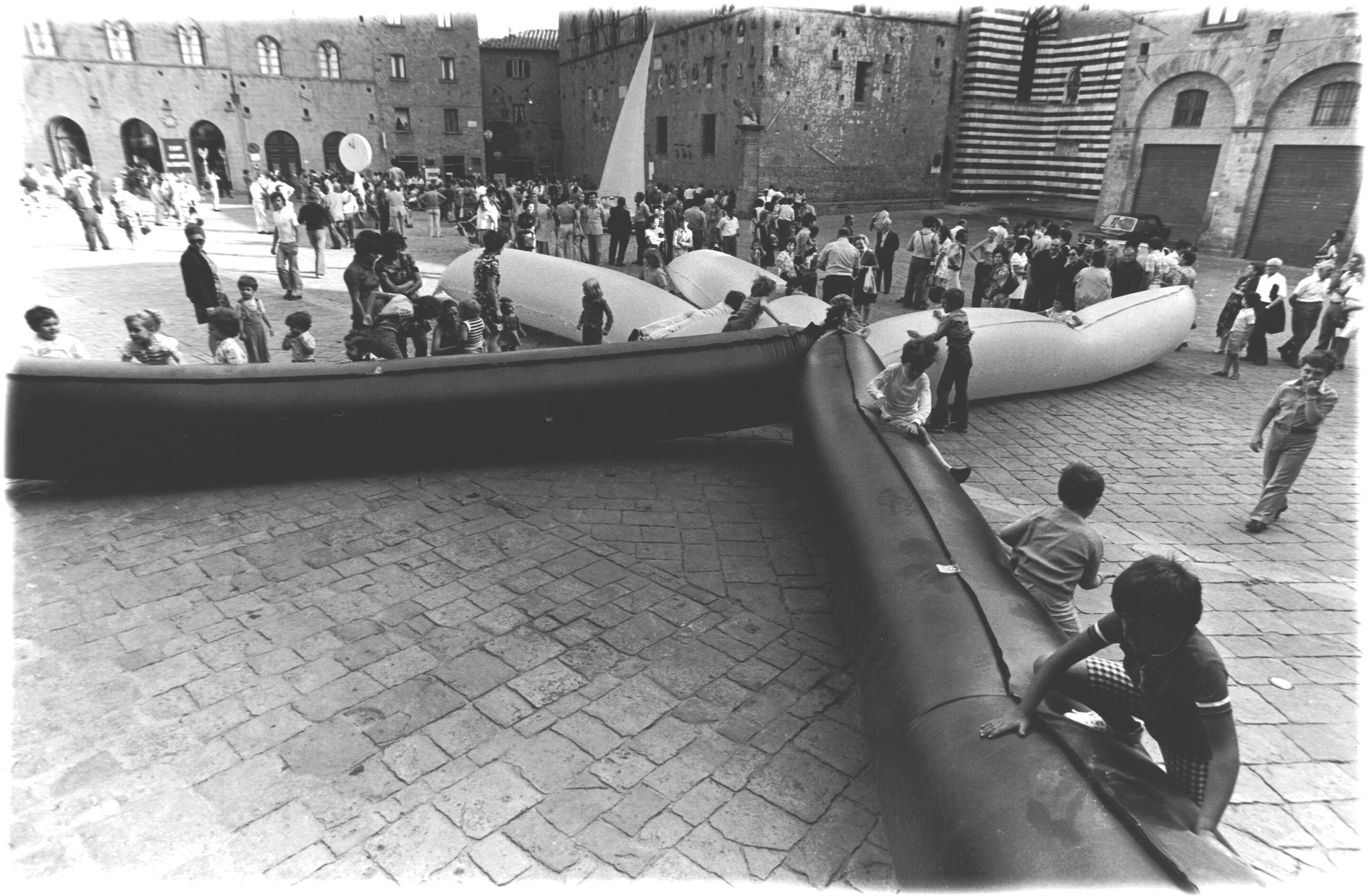
In an Italy marked by political tensions and urban transformations, Franco Mazzucchelli (Milan, 1939) gave form to these impulses with works that did not seek to represent reality, but to act upon it. His intervention at Volterra ’73, an exhibition conceived by critic Enrico Crispolti and artist Mino Trafeli, stands as a prime example, reaffirming the dialogue between sculpture and the city, and highlighting its social and communal dimension.
As Crispolti wrote, “the highest destiny of sculpture is its urban dimension.” Mazzucchelli embraced this concept with both lightness and radicality. His PVC inflatables — light, mutable, ephemeral sculptures — did not celebrate heroes or commemorate events, but restored to public space its original function as a place of encounter.
Through his inflatable installations, Mazzucchelli freed sculpture from the weight of bronze and marble, returning it to air and to everyday life. Museum MAN’s exhibition dedicated to Franco Mazzucchelli, entitled Blow up, retraces this pivotal transition. His monumental PVC inflatables, set up without authorization in public spaces, in front of schools and factories, did not ask to be looked at but to be touched, inhabited, sometimes even stolen. The artist would then document the reactions of passersby, transforming the act of “letting go” into a gesture of shared experience.
Today, Blow up renews that reflection, bringing back to the forefront the idea that the museum is not a separate place, but a living organism in constant dialogue. From the museum to the city, from the city to the museum, art continues to question its own role, to rewrite the relationship between work and viewer, and to measure the distance and the closeness between aesthetics and life.